> For the complete documentation index, see [llms.txt](https://docs.kernel.ai/llms.txt). Markdown versions of documentation pages are available by appending `.md` to page URLs; this page is available as [Markdown](https://docs.kernel.ai/data/hierarchies/parent-relationships.md).

# Parent relationships

Kernel resolves parent relationships after it has resolved the account to a specific entity. The goal is to show where that entity sits in the corporate tree without changing the entity itself.

The same company family can have several useful parent answers. A CRM hierarchy usually needs the direct parent. Reporting and routing often need the top of the tree. GTM workflows sometimes need the highest operating company rather than a passive holding company.

## Types of parent

Each parent relationship includes data about the parent entity, not just a relationship label. That can include the parent name, legal name, KERN ID, website, and other core entity details Kernel has for that parent. This lets teams map parent records into CRM fields, routing rules, and reporting tables without doing a separate lookup first.

| Relationship         | What it means                                                                                                                                    | Use it for                                                                        |
| -------------------- | ------------------------------------------------------------------------------------------------------------------------------------------------ | --------------------------------------------------------------------------------- |
| Immediate parent     | The parent entity one level above the account. It is empty when the entity is standalone.                                                        | CRM parent fields, association actions, and hierarchy cleanup                     |
| Top parent           | The ultimate parent at the top of the corporate tree. For a company at the top of its tree, this points to the company itself.                   | Account-family rollups, global routing, group-level reporting, and dedupe context |
| Top operating parent | The highest operating parent in the tree, excluding holding or investment entities. Empty when no operating company sits at or above the entity. | GTM reporting and routing that should skip holding companies                      |

## Example

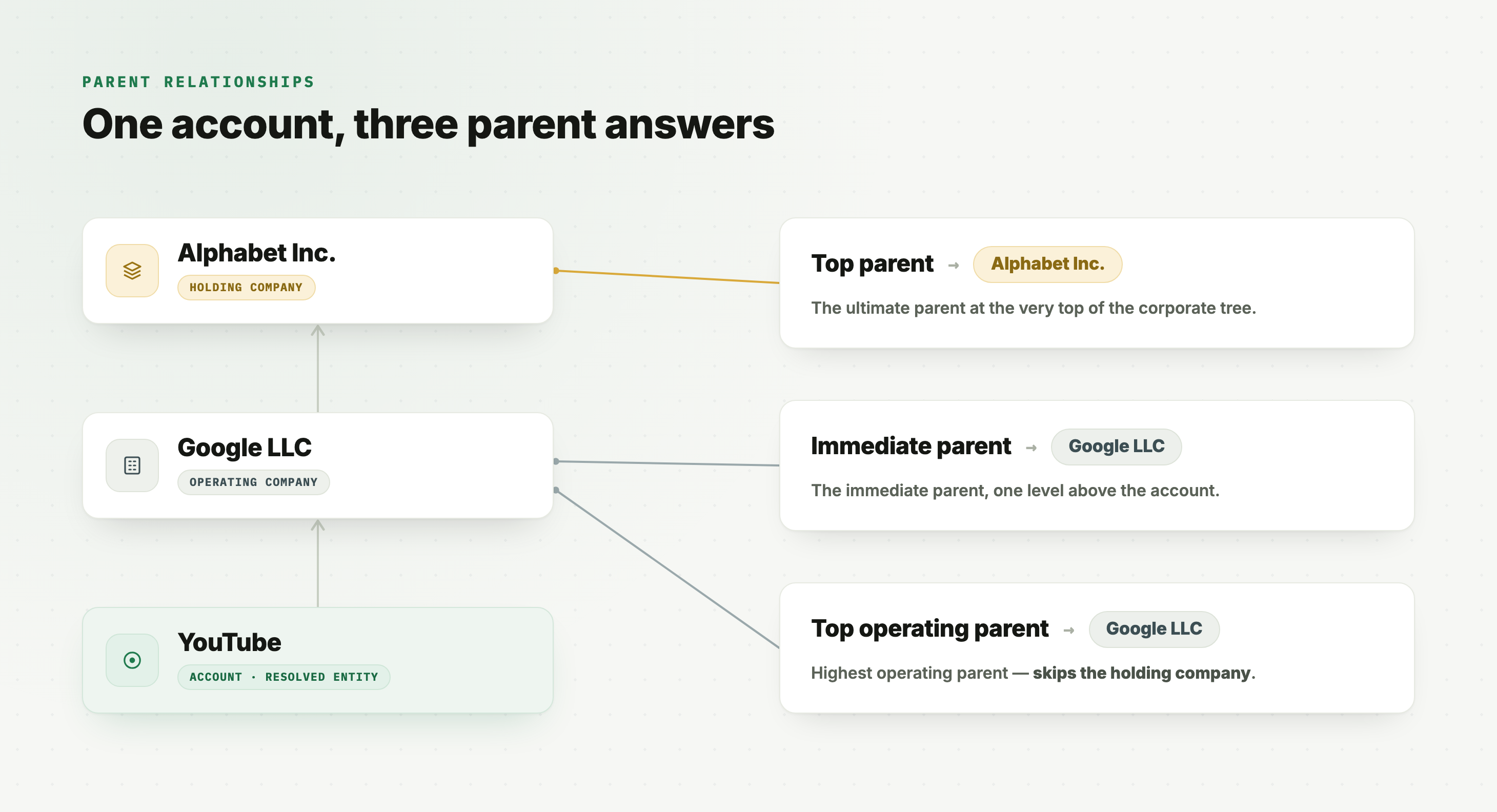
<figure><img src="/files/zPYPjvuBSOxrNYI7BaMo" alt="Corporate tree for YouTube: the immediate parent and top operating parent both resolve to Google LLC, while the top parent resolves to Alphabet Inc. at the top of the tree"><figcaption><p>Alphabet is a holding company, so the top operating parent stops at Google LLC, the highest operating company, while the top parent continues to the top of the tree.</p></figcaption></figure>

For YouTube:

| Relationship         | Entity        |
| -------------------- | ------------- |
| Account              | YouTube       |
| Immediate parent     | Google LLC    |
| Top parent           | Alphabet Inc. |
| Top operating parent | Google LLC    |

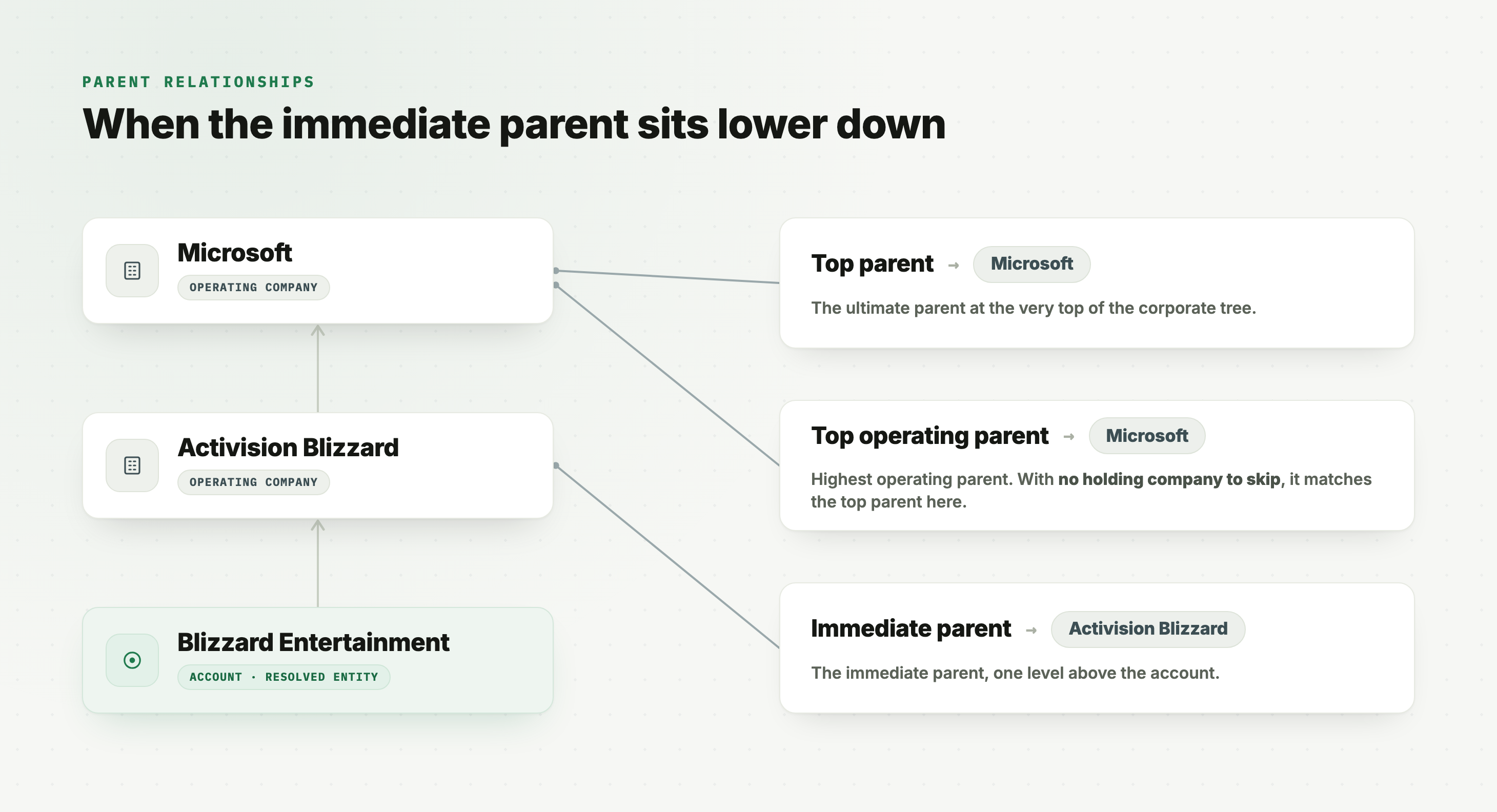
Here the immediate parent and the top operating parent match, because Google is already the highest operating company beneath the holding company. That is not always the case. When an account sits under a mid-tier operating company, the immediate parent and the top operating parent differ:

<figure><img src="/files/ZdCcLsGfmsDRd2lXcbb3" alt="Corporate tree for Blizzard Entertainment: the immediate parent resolves to Activision Blizzard, while the top operating parent and top parent both resolve to Microsoft"><figcaption><p>There is no holding company to skip, so the top operating parent equals the top parent (Microsoft). The immediate parent is the mid-tier operating company, Activision Blizzard.</p></figcaption></figure>

For Blizzard Entertainment:

| Relationship         | Entity                 |
| -------------------- | ---------------------- |
| Account              | Blizzard Entertainment |
| Immediate parent     | Activision Blizzard    |
| Top parent           | Microsoft              |
| Top operating parent | Microsoft              |

## When a company has no parent

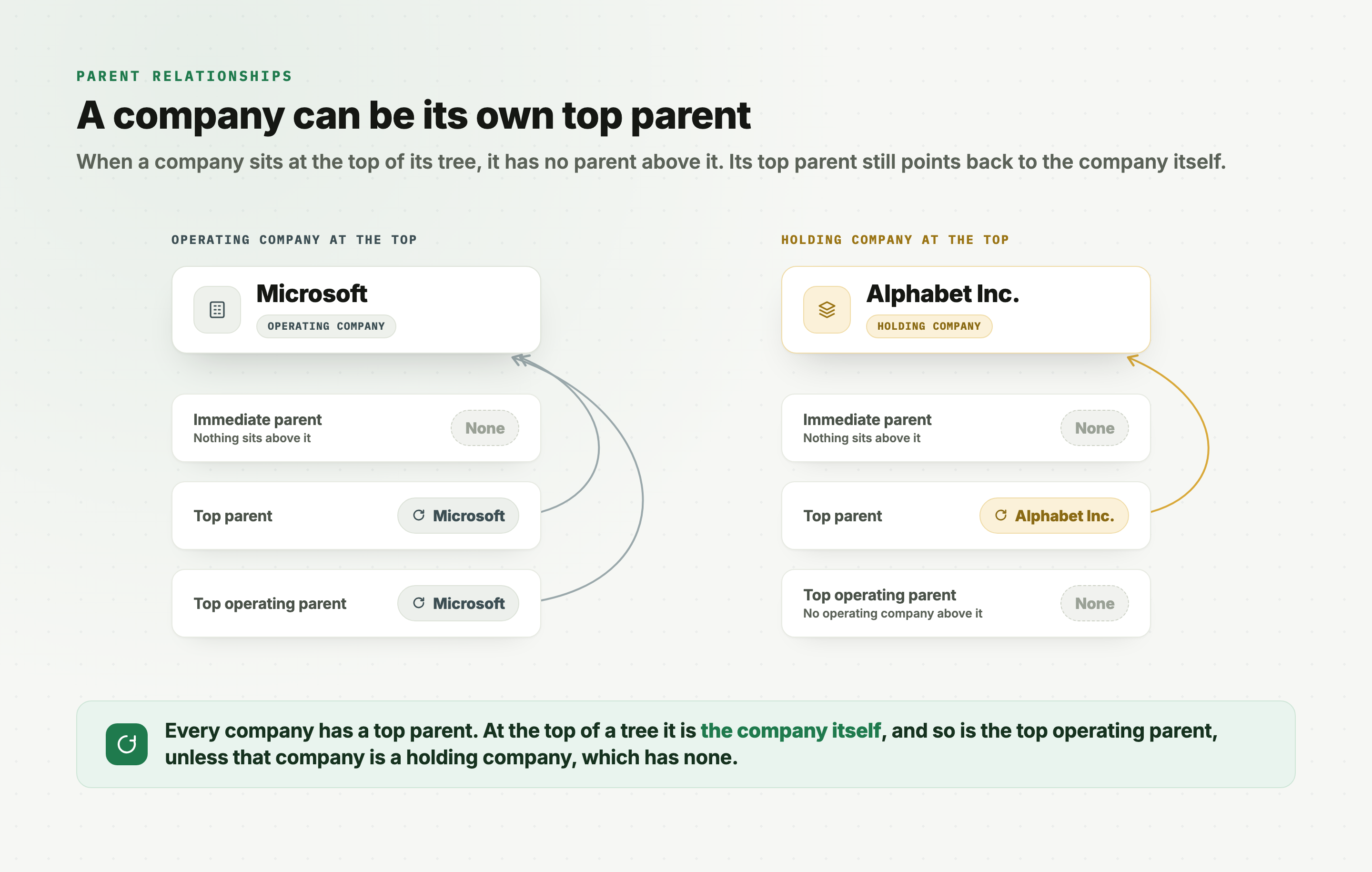
Some companies sit at the top of their tree. Nothing owns them, so they have no immediate parent. This applies both to a genuinely standalone company and to the ultimate parent of a large group.

These companies still have a top parent. The top parent is the company at the very top of the tree, so when a company is already at the top, its top parent is the company itself. Every resolved company has a top parent, and it is never empty.

<figure><img src="/files/u89qGhP93WYKvwXIM41S" alt="Two companies at the top of their trees. Microsoft, an operating company, is its own top parent and its own top operating parent. Alphabet Inc., a holding company, is its own top parent but has no top operating parent."><figcaption><p>A company at the top of its tree is its own top parent. It is its own top operating parent too, unless it is a holding company, in which case no operating company sits at or above it.</p></figcaption></figure>

The top operating parent works the same way, with one exception. It is the highest operating company in the tree:

* When the company at the top is an operating company, it is its own top operating parent, just as it is its own top parent. Microsoft is an example.
* When the company at the top is a holding company, there is no operating company at or above it, so the top operating parent is empty. The operating companies sit further down the tree, not above it. Alphabet is an example.

When you read these values back, a top parent that equals the account is not a data gap. It tells you the account is already the top of its tree. An empty top operating parent tells you either the account has no parent chain, or the top of that chain is a holding company.

## Which parent should I use?

Use the immediate parent when you want to write or repair the CRM hierarchy itself. This is the relationship Kernel uses for association actions, because CRM parent fields usually represent a direct parent-child link.

Use the top parent when the question is about the whole account family. This is usually the right value for group reporting, global account lists, territory rules that roll up to the full corporate group, and duplicate review context.

Use the top operating parent when the legal top parent is a holding company but the useful GTM anchor is the operating business below it. This keeps ownership structure visible without forcing every sales or routing workflow to anchor on a passive holding company.

## What Kernel does with parent relationships

Kernel keeps parent relationships separate from merge decisions. A subsidiary, business unit, or regional arm can be related to a parent without becoming the same entity as the parent.

In the app, parent recommendations appear in [Associate hierarchies](/app/actioning/associate.md). Kernel can suggest linking a child to an existing parent, reparenting a child, creating a missing parent, or removing an incorrect parent relationship.